Once I started spending more time under the stars with my 70mm refractor, I realized that simply finding planets wasn’t enough. I wanted to understand the sky as a whole, to know where I was looking, how constellations connect to one another, and how to move confidently from one part of the sky to the next. Many atlases felt cold and technical, but Star Finder! immediately stood out as something different: visual, logical, and genuinely inviting.
A Route-Based Approach That Actually Works
One of the book’s strongest ideas is its use of clearly defined sky routes. Instead of treating constellations as isolated shapes, the book organizes them into connected paths across the night sky. Routes like “The Big Dipper to Leo”, “Orion to the Pleiades”, or “Cassiopeia to Aries” give you a natural sense of direction and progression.
Each route begins with a bright, easily recognizable constellation and then guides you step by step toward neighboring targets. This makes navigation feel intuitive — you are always moving from something familiar toward something new, rather than guessing where to look next.
Star Hopping Explained Visually
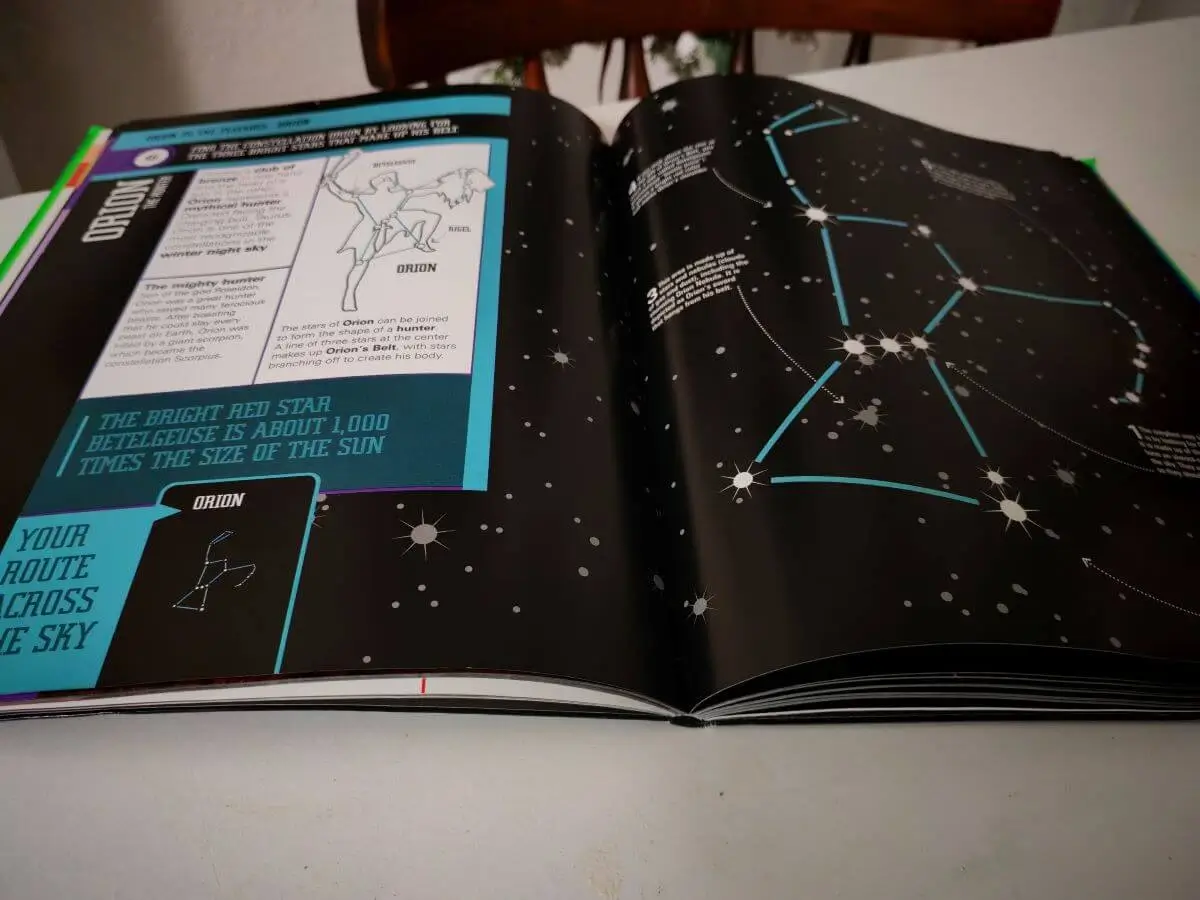
Star hopping is not just mentioned — it is shown. Clear lines, color-coded stars, and uncluttered backgrounds demonstrate exactly how to trace imaginary paths between bright reference stars. For example, tracing a line down from the pointer stars of the Big Dipper leads you directly to Leo, just as you would do at the eyepiece.
This visual clarity removes a lot of frustration. You are not memorizing abstract diagrams; you are learning practical techniques that translate directly to the real sky.
Rich Constellation Cards for Every Chapter
Each chapter is supported by rich constellation cards that combine star maps, mythology, astronomy facts, and observing tips into a single, well-designed layout. These cards don’t just show star positions — they explain what you’re looking at and why it matters.
In the Leo section, for example, the book explains how the constellation represents the lion of Greek mythology defeated by Heracles during his first labor. It highlights key stars such as Regulus, Leo’s brightest star, located about 79 light-years from Earth, and explains how the famous “Sickle” asterism forms the lion’s head in the shape of a backwards question mark.
More Than an Atlas
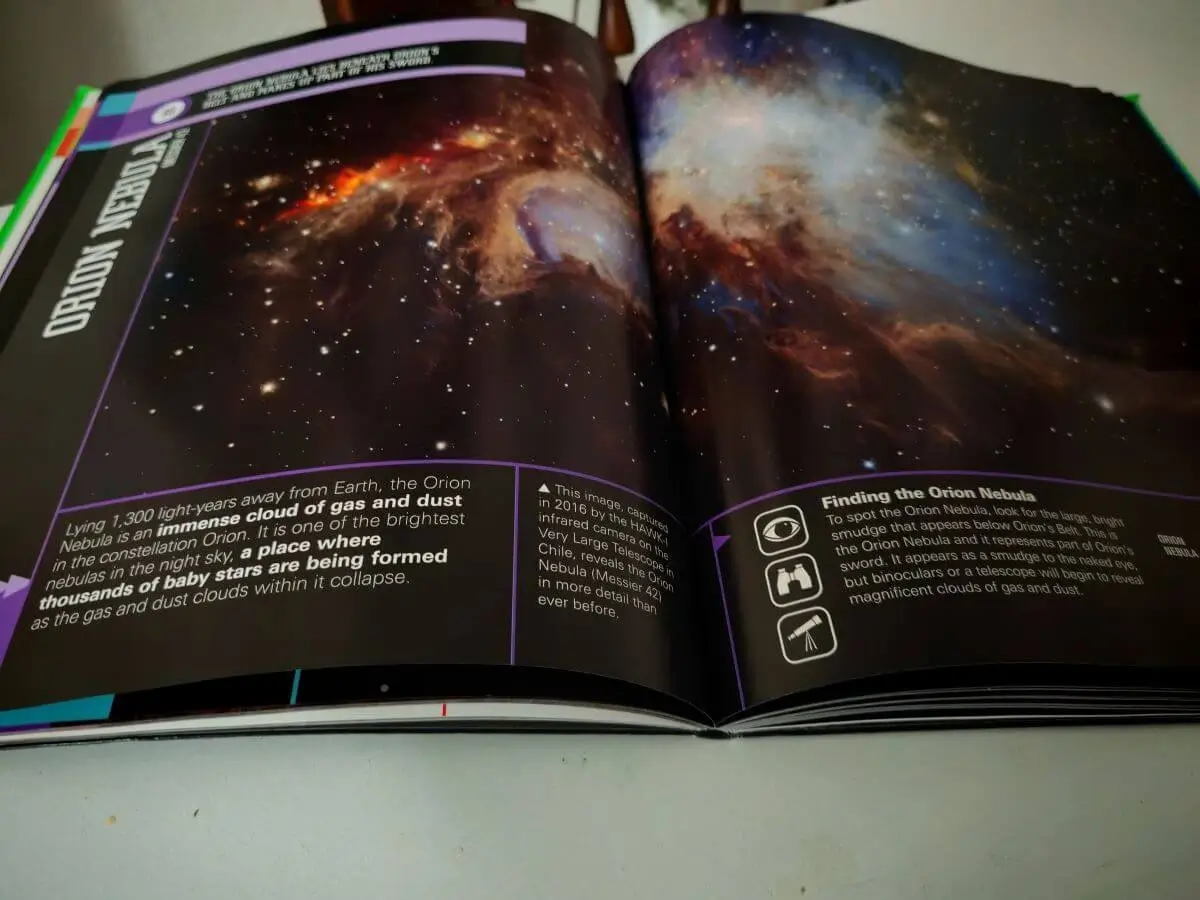
Beyond constellation shapes, the book seamlessly introduces deep-sky objects along each route. Galaxies like the Whirlpool Galaxy and Andromeda Galaxy, nebulae such as the Orion Nebula and Crab Nebula, and even compact targets like Messier 5 or Stephan’s Quintet are placed into proper context instead of being listed randomly.
This makes Star Finder! feel like a guided observing session rather than a reference book. On cloudy nights, it’s just as enjoyable to read as it is to use outdoors.
The Best Constellation Atlas I Own
After using many different sky guides, I can honestly say this is the most practical constellation atlas in my collection. The maps are clean, the structure makes sense, and the learning curve is gentle without ever feeling simplistic. It works beautifully with the naked eye, binoculars, or a small telescope.
Paired with my 7x50 Bresser Hunter binoculars, it has become my default companion for relaxed backyard sessions — the kind where learning and enjoyment go hand in hand.
Final Verdict: Learning the Sky, One Route at a Time
Star Finder! teaches you how to move across the night sky with confidence. By combining logical routes, beautifully designed constellation cards, and clear star-hopping techniques, it turns a confusing sky into a connected, understandable whole.
It is an ideal book for beginners, families, and anyone who wants to truly learn the constellations — not just recognize their names, but understand how they fit together above our heads.