The Acuter Newtony 50 Discovery is one of those rare small telescopes that manages to stand out in a crowded field of toy-like beginner scopes. While its modest 50 mm aperture and 200 mm focal length place it firmly in the budget category, many observers and amateur astronomers have been pleasantly surprised by what this little Newtonian can deliver. In this review, we explore both the standard and the DIY version, outline realistic expectations, and explain why this telescope often earns praise beyond its size.
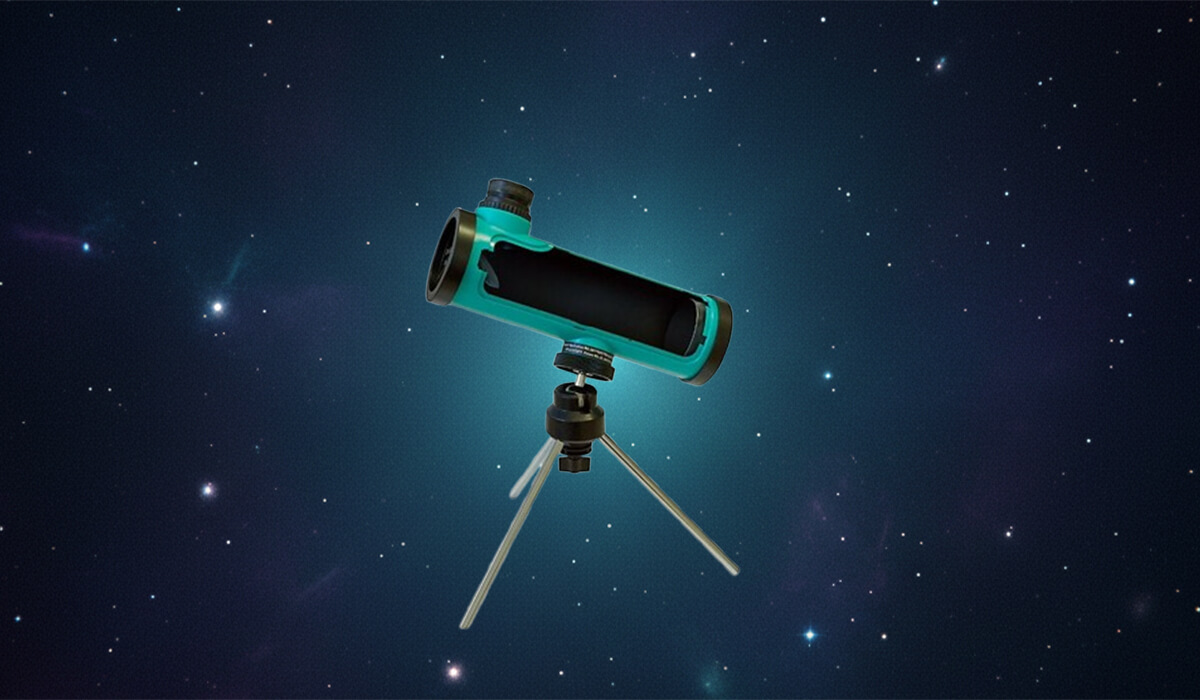
Standard vs DIY Version
The Acuter Newtony 50 comes in two configurations: the standard model and the DIY (Do-It-Yourself) variant. The standard version is ready to use out of the box and ideal for beginners who just want to point, focus, and observe. The DIY version, on the other hand, is designed for those who enjoy assembling and understanding the mechanics of their telescope first-hand — a great learning experience for curious minds and hobby builders.
Both versions share the same optical design and performance characteristics, but the DIY variant emphasizes hands-on involvement and deeper familiarity with how a Newtonian reflector works. This can make it especially rewarding for students or parents who want to explore science with their kids beyond simple observation.
How It Works
The Acuter Newtony 50 is a very small Newtonian reflector that uses a spherical primary mirror to collect incoming light. That light is reflected toward a small secondary mirror, which redirects it into the eyepiece where the image is formed. Like all Newtonian designs, it relies on mirrors rather than lenses, keeping the optical system simple and affordable.
At this size, the telescope is not about extracting fine detail, but about understanding the basics of how a reflector works. It allows beginners to see how focusing, magnification and alignment affect the view, making it a practical tool for learning rather than a telescope meant to impress with dramatic images.
Real-World Performance
In real observing conditions, expectations need to remain realistic. With a 50 mm aperture, the Newtony 50 performs best on bright targets. The Moon is its strongest subject, where large craters and surface contrasts can be clearly recognized, especially at low to moderate magnifications.
Bright planets such as Jupiter and Saturn appear as small, distinct objects rather than detailed worlds. Jupiter can be identified as a tiny disk, sometimes accompanied by its brightest moons, while Saturn is visible as a small oval shape under steady conditions. These views are subtle, but they are genuine — and often more satisfying than what typical “toy telescopes” manage to deliver.
Many amateur astronomers have noted that, within its limits, the Newtony 50 performs better than expected when properly collimated and used at sensible magnifications. It rewards patience and careful observing, rather than promising instant results.
Limitations You Should Know
The primary limitation of the Acuter Newtony 50 is its aperture. With only 50 mm of light-gathering capability, faint deep-sky objects such as galaxies and most nebulae remain out of reach. This is not a design flaw, but a physical limitation shared by all telescopes of similar size.
The included mount is simple and intended for casual use. While adequate for short observing sessions, it does not provide the stability needed for high magnifications. Keeping magnification modest results in a more comfortable and enjoyable experience. The DIY version offers the opportunity to improve mechanical alignment during assembly, which can slightly enhance usability and stability.
Final Thoughts
The Acuter Newtony 50 Discovery telescope may not be a powerhouse, but that’s not its goal. What it does offer is an accessible entry into reflector optics with real viewing potential far above what you’ll find in toy telescopes. Whether you pick the ready-to-use standard model or the engaging DIY version, you’re getting an instrument that encourages learning, experimentation, and genuine sky watching.
Many observers are pleasantly surprised at how much they can see with this scope. It won’t replace larger or more advanced telescopes, but it *will* sit comfortably on a beginner’s observing bench as a dependable and fun companion.
If you’re ready to explore the Moon, glimpse planets, and get a hands-on introduction to telescope optics, the Acuter Newtony 50 Discovery remains an excellent choice.
Check Prices on Astroshop